
Control System UV-C Lamp and Room Temperature Based Internet of Things
##plugins.themes.bootstrap3.article.sidebar##
##plugins.themes.bootstrap3.article.main##
Abstract
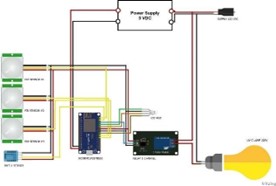
At the beginning of 2020, the world was shocked by the emergence of a new virus, Severe Acute Respiratory Syndrome Coronavirus-2 (SARS-nCoV- 2) and the name of the disease is Coronavirus Disease 2019 (COVID-19). Common symptoms of COVID-19 are acute respiratory distress, fever, cough and shortness of breath. One of the efforts to overcome the transmission of COVID-19 is by sterilizing the room. This research designs an automatic room sterilization device using UV-C lamps that can be controlled using the Blynk application. There are 2 working principles of this tool, namely automatic, the lamp will turn on according to a predetermined setpoint and manual, the lamp will turn on manually like a normal lamp. Hardware used to make this tool are NodeMCU ESP8266, DHT11 sensor, PIR sensor, UV-C lamp, and Relay. As for the software used are Arduino IDE and Blynk Application. This research has 3 tests, the first is testing the lamp automation system where the UV-C lamp response is in accordance with the notification in the Blynk application. The second test is a human detection system with a PIR sensor where the sensor can detect with a maximum radius of 5m. The third test of room temperature monitoring system with DHT11 sensor with digital thermometer comparison tool. The average error value is 0.88% with the accuracy of the DHT11 sensor of 99.12%
##plugins.themes.bootstrap3.article.details##

This work is licensed under a Creative Commons Attribution-ShareAlike 4.0 International License.
Authors who publish articles in CoreID Journal agree to the following terms:
- Authors retain copyright of the article and grant the journal right of first publication with the work simultaneously licensed under a CC-BY-SA or The Creative Commons Attribution–ShareAlike License.
- Authors are able to enter into separate, additional contractual arrangements for the non-exclusive distribution of the journal's published version of the work (e.g., post it to an institutional repository or publish it in a book), with an acknowledgment of its initial publication in this journal.
- Authors are permitted and encouraged to post their work online (e.g., in institutional repositories or on their website) prior to and during the submission process, as it can lead to productive exchanges, as well as earlier and greater citation of published work (See The Effect of Open Access).
References
Y. Yuliana, “Corona virus diseases (Covid-19): Sebuah tinjauan literatur,” Wellness Heal. Mag., vol. 2, no. 1, pp. 187–192, Mar. 2020.
Q. Gao, Y. Hu, Z. Dai, F. Xiao, J. Wang, and J. Wu, “The Epidemiological Characteristics of 2019 Novel Coronavirus Diseases (COVID-19) in Jingmen, China,” SSRN Electron. J., vol. 2, no. 8, pp. 113–122, 2020.
B. Mohan and N. Vinod, “COVID-19: An Insight into SARS-CoV2 Pandemic Originated at Wuhan City in Hubei Province of China,” J. Infect. Dis. Epidemiol., vol. 6, no. 4, Jul. 2020.
H.W.Z.W.Y.D.R.C.C.X.Y.S.Z.L.T.M.S.J.H.Y.W.G.X.T.S.X.Z.Y.Cai,“Phase-adjusted estimation of the number of Coronavirus Disease 2019 cases in Wuhan, China,” Cell Discov., vol. 6, no. 10, 2020.
M. A. Shereen, S. Khan, A. Kazmi, N. Bashir, and R. Siddique, “COVID-19 infection: Origin, transmission, and characteristics of human coronaviruses,” Journal of Advanced Research, vol. 24. Elsevier B.V., pp. 91–98, 01-Jul-2020.
T. Dzieciatkowski, L. Szarpak, K. J. Filipiak, M. Jaguszewski, J. R. Ladny, and J. Smereka, “COVID- 19 challenge for modern medicine,” Cardiol. J., vol. 27, no. 2, pp. 175–183, May 2020.
K. J. Goh et al., “Rapid Progression to Acute Respiratory Distress Syndrome: Review of Current Understanding of Critical Illness from Coronavirus Disease 2019 (COVID-19) Infection,” Ann. Acad. Med. Singapore, 2020.
Y. Sumarni, “Pandemi Covid-19: Tantangan Ekonomi dan Bisnis,” Al-Intaj J. Ekon. dan Perbank. Syariah, vol. 6, no. 2, p. 46, Sep. 2020.
R. Ali Naqvi et al., “Coronavirus: A ‘Mild’ Virus Turned Deadly Infection,” Comput. Mater. Contin., vol. 67, no. 2, pp. 2631–2646, 2021.
Z. Nabila, A. R. Isnain, Permata, and Z. Abidin, “Analisis Data Mining Untuk Clustering Kasus Covid- 19 Di Provinsi Lampung Dengan Algoritma K-Means,” J. Teknol. dan Sist. Inf., vol. 2, no. 2, p. 100, 2021.
P. Wardani, S. Sutisna, and M. Supriyatno, “Leadership Strategies for Facing Threats Non-Military; In The Middle of the Deep Covid-19 Pandemic Non-Military Defense,” Citiz. J. Ilm. Multidisiplin Indones., vol. 2, no. 1, 2022.
J. Prayitno, R. A. Darmawan, J. P. Susanto, and R. Nugroho, “Tinjauan Teknologi Inaktivasi Virus Untuk Penanggulangan Pandemi Covid-19,” J. Bioteknol. Biosains Indones., vol. 8, no. 1, pp. 137– 154, Jun. 2021.
S. Ngudiwaluyo et al., “Healthy Workspace Design in a New Habit Era with Covid Buster Technology in Accordance with the Minister of Health Regulation PMK 1077- 2011,” 2011.
F. Memarzadeh, “A Review of Recent Evidence for Utilizing Ultraviolet Irradiation Technology to Disinfect Both Indoor Air and Surfaces,” Appl. Biosaf., vol. 26, no. 1, pp. 52–56, Mar. 2021.
T. dos Santos and Lívia Furquim de Castro, “Evaluation of a portable Ultraviolet C (UV-C) device for hospital surface decontamination,” Photodiagnosis Photodyn. Ther., vol. 33, 2021.
A. Z. N. Azza, D. F. Amal, F. R. Pinestiti, N. N. Alfian, S. Safiinatunnajah, and D. J. Suroso, “Smart Sterilization System pada Ruang Kelas Berbasis UVC,” J. Inform. Polinema, vol. 7, no. 3, pp. 43–52, Jun. 2021.
Y. Efendi, “Internet Of Things (Iot) Sistem Pengendalian Lampu Menggunakan Raspberry Pi Berbasis Mobile,” J. Ilm. ILMU Komput., vol. 4, no. 1, pp. 19–26, Apr. 2018.
B. Artono and R. G. Putra, “Penerapan Internet Of Things (IoT) Untuk Kontrol Lampu Menggunakan Arduino Berbasis Web,” J. Teknol. Inf. dan Terap., vol. 5, no. 1, pp. 9–16, Apr. 2019.
D. Setiadi and M. N. Abdul Muhaemin, “PENERAPAN INTERNET OF THINGS (IoT) PADA SISTEM MONITORING IRIGASI (SMART IRIGASI),” Infotronik J. Teknol. Inf. dan Elektron., vol. 3, no. 2, p. 95, Dec. 2018.
M. T. A. S. M. N. A. M. K. Ishak, “Monitoring Temperature, Humidity and Controlling System in Industrial Fixed Room Storage Based on IoT,” J. Eng. Sci. Technol., vol. 15, no. 6, 2020.
T. Adiono, M. Y. Fathany, S. Fuada, I. G. Purwanda, and S. F. Anindya, “A portable node of humidity
and temperature sensor for indoor environment monitoring,” in 2018 3rd International Conference on
Intelligent Green Building and Smart Grid (IGBSG), 2018, pp. 1–5.
M. A. A. Razali, M. Kassim, N. A. Sulaiman, and S. Saaidin, “A ThingSpeak IoT on Real Time Room
Condition Monitoring System,” in 2020 IEEE International Conference on Automatic Control and
Intelligent Systems (I2CACIS), 2020, pp. 206–211.
A. P. Susanto, M. Rivai, and T. Tasripan, “Autonomous Docking System untuk Mobile Robot Berbasis
Citra pada Stasiun Pengisian Daya Nirkabel,” J. Tek. ITS, vol. 7, no. 2, Feb. 2019.
A. M. Avi, M. S. Rana, M. B. Bedar, and M. A. Talukder, “An android application and speech recognition-based IoT-enabled deployment using NodeMCU for elderly individuals,” Bull. Electr.
Eng. Informatics, vol. 12, no. 5, pp. 2763–2776, Oct. 2023.
T. Suryana, “Automation and Remote Control of Electronic Equipment Using the Internet with
NODEMCU ESP8266 Interface and Apache MYSQL Web Server,” Indonesian Computer University, 2021.